Day 23 : Third Most Important Thing Teach A Child
As requested, today I will be writing about the third most important thing to teach a child. In case you missed my previous posts, the first thing to teach a child is to love herself. Unless a child has the capacity to value her own life, she can’t reach her full potential or become deeply alive. And that’s true for adults too. The second is emotional literacy. Each child should be helped to read, understand and communicate feelings and emotions with words. It’s the most essential of all skills for we can’t form meaningful relationships unless we know how to interpret behaviour. You asked what next?
I believe after these two, the most important thing we can teach a child is to risk failure and embrace mistakes. Unfortunately, in our reactive ways, we often teach exactly the opposite of this.
Mistakes are part and parcel of any human experience. The prophet saw said, “Every son of Adam commits sin, and the best of those who commit sins are those who repent.” (Sunan Ibn Majah)
Particularly for children, mistakes are consequences of being a child who is yet to fully understand what’s right or wrong in the world. As an adult, we know mistakes help us repent, learn more and grow wiser. Yet, even as an adult, sadly we can’t see beyond our failures sometimes. We all make mistakes but the biggest mistake is losing hope in Allah’s Mercy and dwelling on our sins. Thus we make it difficult for ourselves to move forward. How can we then, with such a fixed mindset, help our children to learn from mistakes and move on? When things go wrong, we cook them and stew them in blame. Blaming, condemning and criticizing, whereas, we should be teaching “Don’t lose hope in Allah’s mercy, for Allah certainly forgives all sins. He is indeed The All-Forgiving and The Most-Merciful” (Qur’an 39:53)
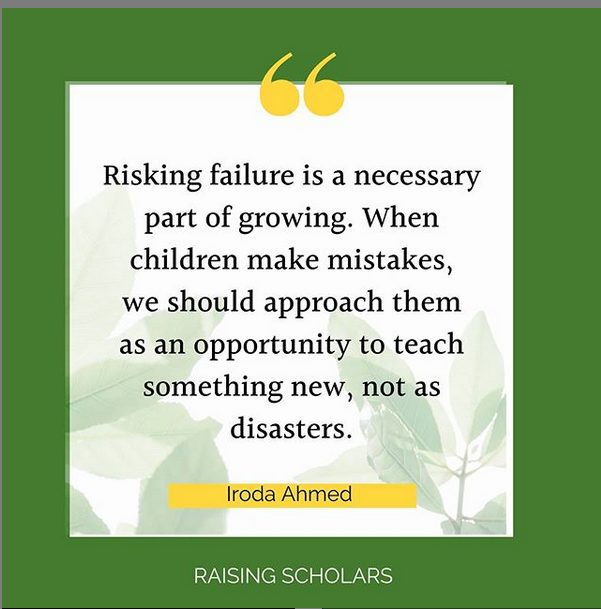
The simple lesson of “risking failure is a necessary part of growing and success” should be taught from a young age. This philosophy is true in business, academic progress and career just as it is true in one’s personal and spiritual development. Children will learn and master this skill from the way we treat them when they make mistakes. The truth is, to learn a new skill, you need the courage to make mistakes. And when children do make mistakes, we can interpret them either as an opportunity to teach something new or as a disaster.
For example, no child is born with the ability to write. Teaching handwriting skills is a particularly painful experience for most homeschoolers. Imagine every time your child wrote B like D and you kept on shouting. Would she feel encouraged to try harder?
What would you do when your 8-year-old tried to cook for a family and the rice got burnt? When you five-year-old decided to put away a bottle of VIMTO and dropped the bottle? When your teenage son frequently misses tarawih? When your daughter got caught talking to strange boys online? When your son got caught with a drug? While some of these may seem acceptable childish behaviour, as the children grow older, there are acts of halal and haram. In Islam, we believe all deeds will start being recorded once children reach puberty. And yet we can’t treat them like an adult beyond the age of 13 or 14. What do we do?
Firstly, we have to realize that making mistakes is an inevitable part of being alive. Abu Huraira reported: The Messenger of Allah, peace and blessings be upon him, said, “By Him in whose hand is my soul, if you did not sin, Allah would replace you with people who would sin and they would seek forgiveness from Allah and he would forgive them.” (Bukhari, Sahih)
Secondly, we have to adopt the prophet’s method of correcting mistakes. We should approach mistakes as teachable moments, not as a cause for name and shame. The prophet s.a.w taught to strive for excellence and yet companions made many mistakes during his lifetime. The way he corrected mistakes was very effective. He never shamed a person but condemned the action only.
Usamah Ibn Zayd narrated that once he was sent out on a military campaign. During the battle, he caught a man and the man said “La ilaaha illaAllah” but Usamah stabbed him to death. Later he felt about it and mentioned the incident to the prophet s.a.w. The prophet s.a.w said, “You killed the man who said ‘’La ilaaha illAllah’?”. Usamah said, “Oh Messenger of Allah, he only said because he was afraid”. To which the prophet s.a.w replied: “How can you know what is in his heart”. Usamah narrated that “The prophet s.a.w kept repeating “How can you know what is in his heart” until I wished that I had not become a Muslim until this day (so all my sins would be forgiven for embracing Islam) (Muslim, Sahih)
SubhanAllah, killing a man is not a minor sin. However, the prophet s.a.w didn’t say “Why did you kill him? How could you do that? You will now enter the hellfire for committing such a gravely sin”.
Once the Prophet came across Abu Masud Al-Ansari beating a slave. The Prophet said only one sentence: “Allah has more power over you than you have over him (the slave).” Abu Masud repented and freed the slave immediately. (Muslim, Sahih)
The prophet s.a.w didn’t say “You’re such a terrible person to beat a slave like this. Why do you beat him? Who do you think you are? How can you do this to a helpless slave?”
Since companions who lived side by side with the prophet s.a.w committed sins, who are we to expect complete perfection from our children?
Since the prophet s.a.w corrected some gravely sins with gentleness who are we to name and shame our children for some childish behaviour?
We must make it clear to our children that making mistakes and risking failure is part of growing. Learning isn’t passing and failing an exam at school. Learning is a long and slow process of gaining a better perspective in life through trial and error. And we can help children to understand this by approaching their mistakes as teachable moments, not as disasters.
By Iroda Ahmed