
Day 24: Are Big Children Big Problem

At one point I had three children under five. I would be exhausted not only cooking, cleaning, and washing but also feeding, bathing and doing all the other tedious jobs that all three of them depended on me heavily. I didn’t have an immediate family to share the childcare duties but I had a dear “mummy” friend in Bradford where I could go anytime to relax. I used to call her ‘bhaji’ meaning big sister in Urdu, and my children used to call her house ‘nanke’.
I remember one day I went to nanke’s. It was one of those days – every bone in my body was aching, every muscle was hurting and a list of endless tasks running wild in my head. I remember saying, “I just wish they would grow faster. At least when they are independent, when they start doing everything by themselves, I will have my hands free. Right now, two need help going to the bathroom and I’m up all night changing nappies for the third. Can you imagine?”. To which bhaji, a mother to three teenage girls at the time, replied “Iroda, small children are small problems. Big children are big problems. Wait until they become teenagers, you would rather be up all night changing nappies. Just enjoy them now”
Not all my children are teenagers yet but Oh boy! How her words came so very true! As children get older our child-related concerns and challenges get bigger too.
Let’s talk about teenagers today.
What happens when a child hits puberty? How come a child who was once so talkative can become so quiet? And when questioned what happened starts grunting unintelligible words under her breath? So withdrawn that makes you wonder how can one possibly spend so much time in their room?
We have lived through a major revolution in parent-child relationships in the past few decades. Currently, there is a great deal of confusion about what it means to be a responsible and yet understanding parent. Surely, we were all teenagers once and we must have given our parents a hard time too. However, today’s parents are facing a challenge that no earlier generation of parents had to deal with. That is instant gratification- today’s children have become a nation of what it wants when it wants it.
Some parents may not know how to set firm limits. Others may choose to give in to their children’s desires because it’s the best wall of defence against being nagged. However, most of us simply don’t know how to make our teenagers accept some rules and regulations we put in place for their healthy growth, both physically, spiritually and emotionally.
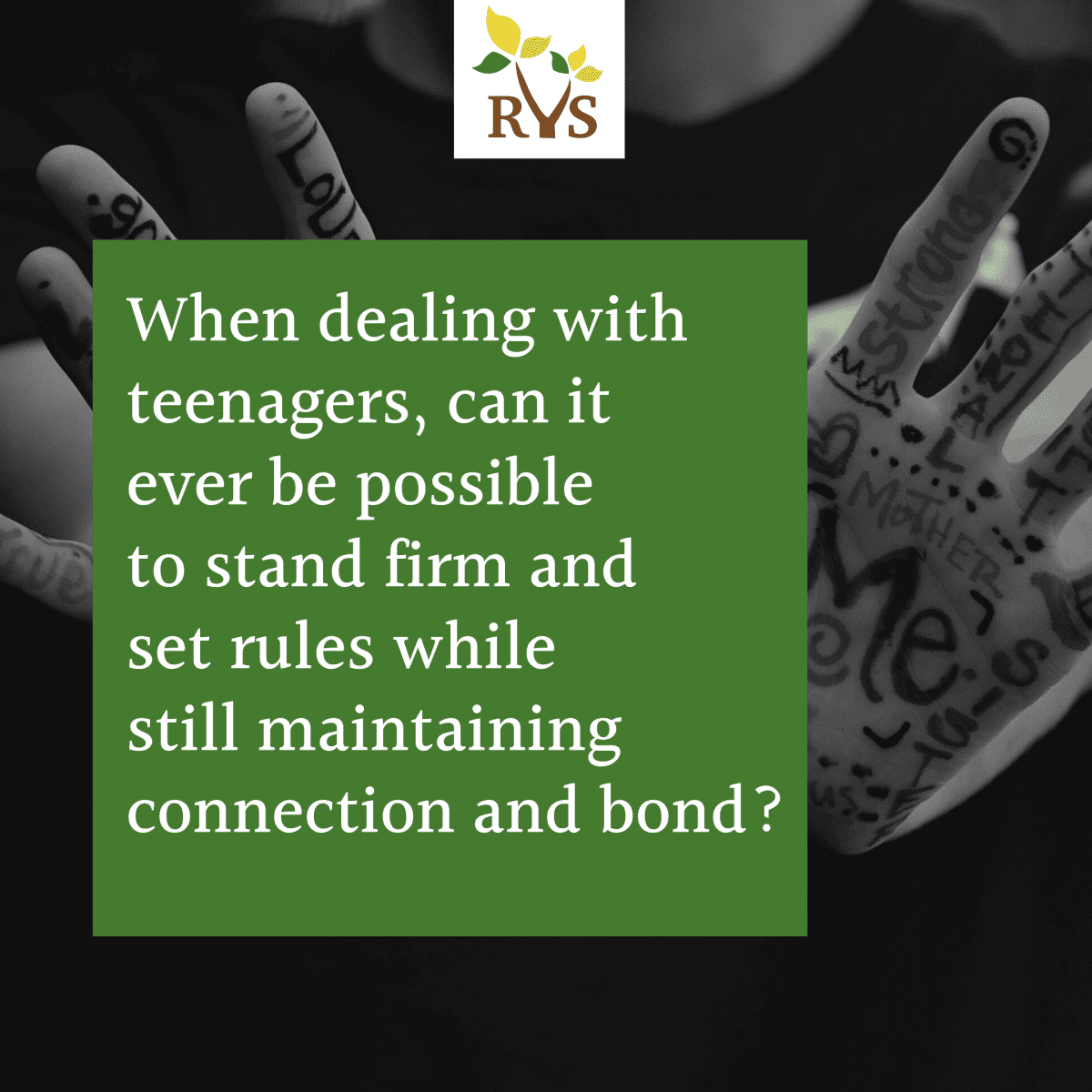
If we choose to take strong and responsible action, it seems at the cost of cutting our relationship with our teenager. If we choose to treat our teenager with sensitivity and concern for their feelings and needs, it seems we may go overboard far too long as to surrender our parental duties completely and not sure of what our role is anymore. Can it ever be possible to stand firm, set rules and be responsible while still maintaining some sort of connection?
I had mostly pleasant experience teaching teenagers. However, I don’t have much experience in dealing with teenagers as a mother yet. From my experience, when dealing with teenagers, we often act like superior intellectuals but with severe defects in our ability to relate to the emotional side of today’s teenagers. This is a period of transition from childhood to adulthood, a time where too much is happening too quickly. This is a period of terrible uncertainty where one spends so much time trying to figure out how to behave towards one’s parents, towards peers and towards other adults. And figuring out how to keep them all pleased at the same time while maintaining one’s ‘cool’ must be a tough mission. This is a period of painful self-awareness and self-doubt that one wants to hide.
To begin with, we must try to remember as much as possible what it feels like being a teenager. Try to remember what you thought of yourself when you were fifteen. My guess is that most of us thought we were dumb and ugly. Most of us were furious at ourselves for failing some of our parent’s expectations and yet unsure how to make amends.
Today I will leave you with more questions than answers.
How would you want to be treated when you are terribly unsure of yourself?
How would you want to be heard when you don’t know who you are yet?
How would you want to be seen when you are still too self-conscious?
How would you want to be talked to when you have overwhelming thoughts and too personal feelings that you need and you want to share but desperately longing to remain anonymous while doing so?
What would you say to your fifteen-year-old self?
You can’t time travel to the past. However, today you can say those words to your teenager. Say them loud and clear.
By Iroda Ahmed