
Teaching Mediocrity: Tips to stay sane in an excellence obsessed world
I have been writing about parenting and education for quite some time now, my own tryst with both has been exciting and challenging at the same time, and what i have figured out in the past few years as a mother, an educator and a researcher on the topic, is the importance of teaching our kids ‘mediocrity’ . We live in a world that is far obsessed with perfection and excellence, and anything not coming under the bounds, is considered not worthwhile, while some of us are blessed and might naturally fall into the category without much perseverance, what’s bothersome is the many others for whom it doesn’t come as naturally and they have to work their way hard, beyond the reasonable limits, just to enter the league, and in the process we are creating a society driven by pressure and not the quest to learn and perform.
This is creating a perilous learning environment , everyone is a part of the sin game- parents, educators and the society by and large, all are equally responsible , and the victims are the poor children or students who without any choice of their own fall into the trap. Not only does this create an unsurmountable pressure, but in the process dilutes the essence of logical learning.

Do you know that some of the brightest and most intelligent minds of our century , Thomas Edison, Benjamin Franklin, Albert Einstein and Bill Gates to name a few, have been school/college/university dropouts, who could not conform to the structured teaching pedagogy, or cope with the unwarranted stress associated with the traditional teaching environment, yet they have carved more than successful careers for themselves, all because of their non-conformation , their quest for knowledge and trying new things ,they might have failed several times before finally arriving and thereby leading to all the major discoveries and innovations in our century.
Shawn Achor, an author, a psychologist and a happiness researcher, conducted research at Harvard, which shows that college grades aren’t any more predictive of subsequent life success than rolling dice. A study of over seven hundred American millionaires showed their average college GPA was 2.9.
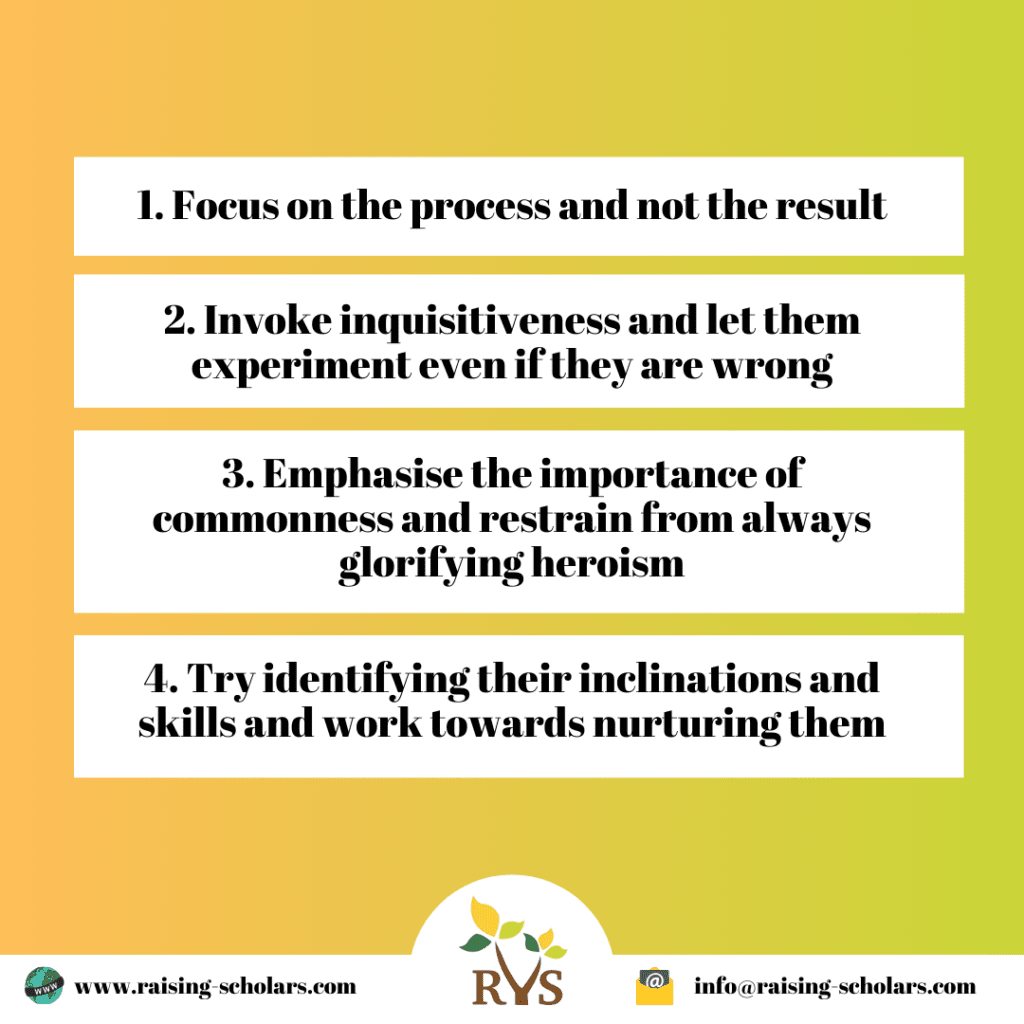
This blog points out 4 ways in which we as educators and parents, can contribute to building a sane society and an environment that stimulates inquisitiveness and passion for learning and performing, and not succumbing to pressure:
1. Focus on the process and not the result :
Its very common for us as parents and educators to use the end result as a yardstick for measuring success , this notion is setting a very wrong trend and hence should be shunned , right from the beginning the child should be made aware that he/she will be appreciated for the effort and not the result. Do not belittle any effort made by your kids, be it small or big, towards learning.
2. Invoke inquisitiveness and let them experiment even if they are wrong:
A lot of us are living a life full of regrets, studies show that the majority of our regrets arise not from what we’ve done but rather from what we’ve not done. So it’s important to let kids explore, make their own mistakes arrive at their own conclusions, all through their own experimentation. While I am not an opponent of guiding and supervising the academic dimension , what I believe is detrimental to their success is over obsession in their pursuits and imposition of our own choices on them.
3. Emphasise the importance of commonness and restrain from always glorifying heroism:
It’s very critical to teach kids that while excellence is most welcome, there is no harm in mediocrity. Read stories about common characters with ordinary pursuits, nothing extraordinary about them. There is no shame in being mediocre, while we all have an area or pursuit we are naturally blessed and skilled at , it’s a matter of right opportunities and correct timing to recognise and nurture it , but at the same time it’s equally important to be consistent and just be average.
4. Try identifying their inclinations and skills and work towards nurturing them:
Not all of us will excel in the same department, this world is so beautiful only because of its diversity, we all are different with different capabilities and skill set, it’s not wise to push everyone in the same direction, while some of us will be brilliant in our academic pursuits, the others will have creative excellence , only a right and mindful educator/parent can recognize that and work towards nurturing the skill in our student/child.